
With MLS on a month-long break and Messi & Friends suiting up for Inter Miami, I took some time to build some projections for the Leagues Cup. The tournament begins Friday, July 21st.
Tournament Structure
First things first, let’s understand the structure of the expanded Leagues Cup tournament.
The tournament combines the 18 clubs from Liga MX, the clubs 29 from MLS into a World-Cup style format with a group stage then knockout rounds. LAFC and Pachuca get a spot directly into the knockout round. LAFC for winning MLS Cup in 2022, and Pachuca for having the most combined points across the Clausura and Apertura seasons. Most of the time the bye is an advantage. But here, LAFC and Pachuca will go two-and-a-half weeks without playing a game. There is potential for some rust to show in that Round of 32 game.
The other 45 teams are organized into 15 groups of 3. Lastly, the knockout round is single elimination but which team hosts the match is unique.
From the Leagues Cup Rules:
Venues: In 2023, advancing MLS clubs will host knockout round matches against LIGA MX teams, and MLS venues will host all Leagues Cup knockout round matches. Round of 32 matches between two MLS clubs will be hosted by the group winner. Round of 32 matches between two LIGA MX clubs will be hosted at a regional venue designated by the Organizing Committee.
Starting with the Round of 16, matches between two MLS clubs will be hosted by the club with the better 2022 regular season performance. Matches between two LIGA MX clubs will be hosted at a venue designated by the Organizing Committee.
https://www.leaguescup.com/news/2023-match-schedule-and-bracket-announcement
Home-field advantage is massive in these two leagues. So, MLS clubs hosting every match against a Liga MX club is a distinct advantage as the tournament advances.
Ok, let’s get into the good stuff.
On first look at the bracket, the West Quadrant looks the toughest. With LAFC, Seattle, and 3 very good Liga MX teams – Leon, Tigres, and Monterrey, it is a tough road to the semis.

The Odds Board
Here are the odds to win as of July 18:
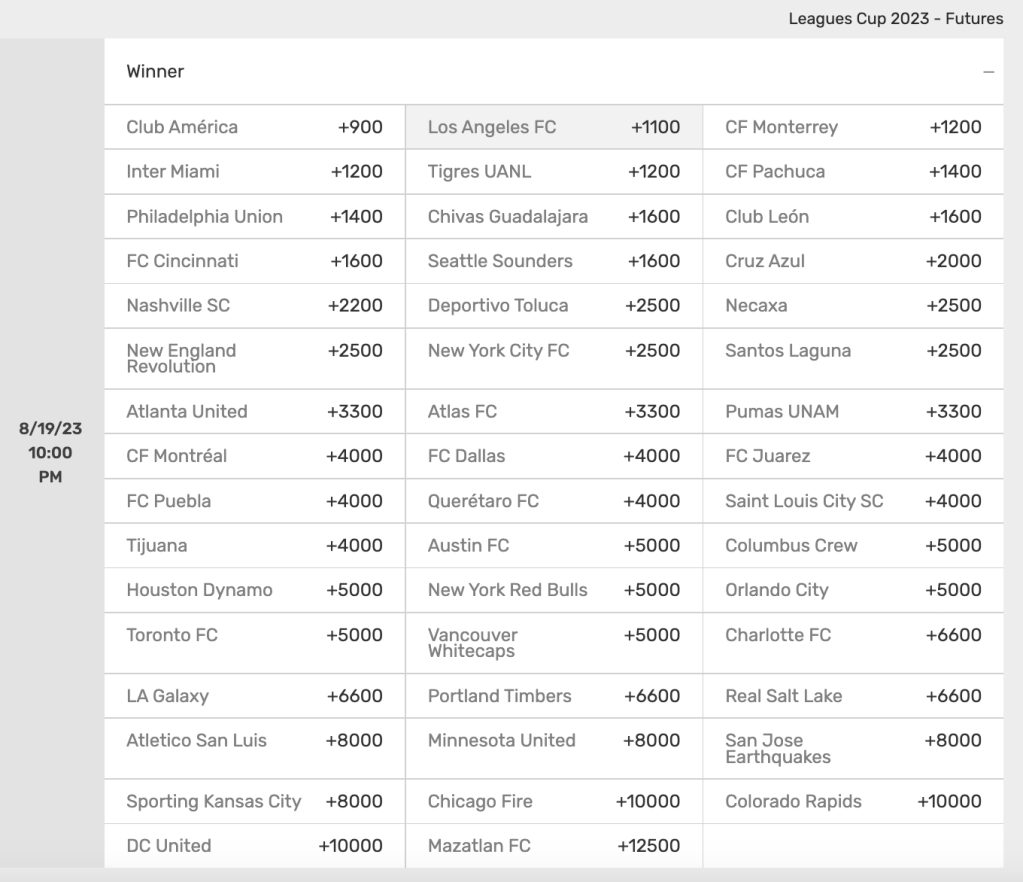
Books are also offering To Win odds for each group, but let’s look at the model first.
Model Methodology
To create the model, I used 3 factors:
- Expected Goals (xG)
- Market Value Adjustment
- League Adjustment
1. Expected Goals (xG)
The model is based on Expected Goals (xG) as the statistic captures team performance better than raw goal differential. For this, I used FBref.
Given Liga MX clubs have only played 3 games in their ongoing Apertura season, I used a weighted average with last year’s Clausura xG. Not ideal, but I can’t use xG with a sample of 3 games. Here are the top 10 teams in raw xGD/90.
| Rank | Team | League | xGF/90 | xGA/90 | xGD/90 |
|---|---|---|---|---|---|
| 1 | Club America | Liga MX | 1.89 | 0.99 | 0.90 |
| 2 | CF Monterrey | Liga MX | 1.82 | 1.07 | 0.76 |
| 3 | Tigres UANL | Liga MX | 1.60 | 0.98 | 0.62 |
| 4 | Seattle Sounders | MLS | 1.54 | 0.98 | 0.57 |
| 5 | LAFC | MLS | 1.54 | 1.09 | 0.45 |
| 6 | Deportivo Toluca | Liga MX | 1.72 | 1.28 | 0.45 |
| 7 | CF Pachuca | Liga MX | 1.78 | 1.34 | 0.44 |
| 8 | NYRB | MLS | 1.33 | 0.95 | 0.38 |
| 9 | FC Cincinnati | MLS | 1.54 | 1.17 | 0.37 |
| 10 | Vancouver Whitecaps | MLS | 1.67 | 1.32 | 0.35 |
2. Market Value Adjustment
In soccer, team value correlates to success. Granted, there is greater correlation in the Big 4 European leagues than smaller leagues like MLS and Liga MX. However, market value gives another sense for the quality in the team. Market Value gives a better assessment than xG for a team like Inter Miami. I think it is safe to assume their performances will improve with the addition of Messi, Busquets, and Jordi Alba.
From TransferMarkt, I found the current club value for all 49 teams.

And here are the adjustments for the top 5 and bottom 5 teams.
| Rank | Team | League | Market Value $M | +/- xGD/90 |
|---|---|---|---|---|
| 1 | Club America | Liga MX | 113.18 | +0.14 |
| 2 | Inter Miami | MLS | 92.49 | +0.11 |
| 3 | CD Guadalajara | Liga MX | 91.31 | +0.10 |
| 4 | Tigres UANL | Liga MX | 90.52 | +0.10 |
| 5 | CF Monterrey | Liga MX | 87.38 | +0.09 |
| 43 | Necaxa | Liga MX | 38.38 | -0.11 |
| 44 | St. Louis City | MLS | 38.38 | -0.11 |
| 45 | FC Juarez | Liga MX | 38.25 | -0.16 |
| 46 | Puebla FC | Liga MX | 31.44 | -0.17 |
| 47 | Queretaro FC | Liga MX | 30.39 | -0.19 |
3. League Adjustment
Lastly, we need to adjust for the difference in quality between Liga MX and MLS. Using GlobalFootballRankings, Liga MX is the 9th best league in the world, and MLS ranks 16th. So, I am increasing the xGD/90 of Liga MX clubs by 9% and decreasing xGD/90 for MLS clubs by 5.5%.

At last, we get to a final ranking.

Obviously, Inter Miami’s potential is not captured here. But, manually adding +1.0xGD/90 puts them in 10th. Just too many unknowns to back them here.
Plays
Four teams stand out, Philadelphia Union, Minnesota United, Deportivo Toluca, and Santos Laguna.
Union (14-1) – The East bracket is weak. Philly has two lower-level Liga MX teams in their group and play both of their group stage games at home.
Minnesota United (80-1) – They will likely have the best player on the field in every game with Emanuel Reynoso. The signing of Pukki gives them much needed finishing presence. 6th best xGD in MLS at 80-1. I’ll take it.
Deportivo Toluca (25-1) and Santos Laguna (25-1) both show value as comfortably the best team in their respective groups. Santos Laguna also have both group stage matches at home.
Lastly, I restrained myself from taking NYRB to win, but I will take them to win Group E4 at +225.
 The4thDP
Leave a comment